|
Pouyan Navard After years of asking “is this publishable?”, I’m increasingly interested in asking “does this actually work?” Building some new set of skills |
PublicationsResearch Interest: Generative AI. |
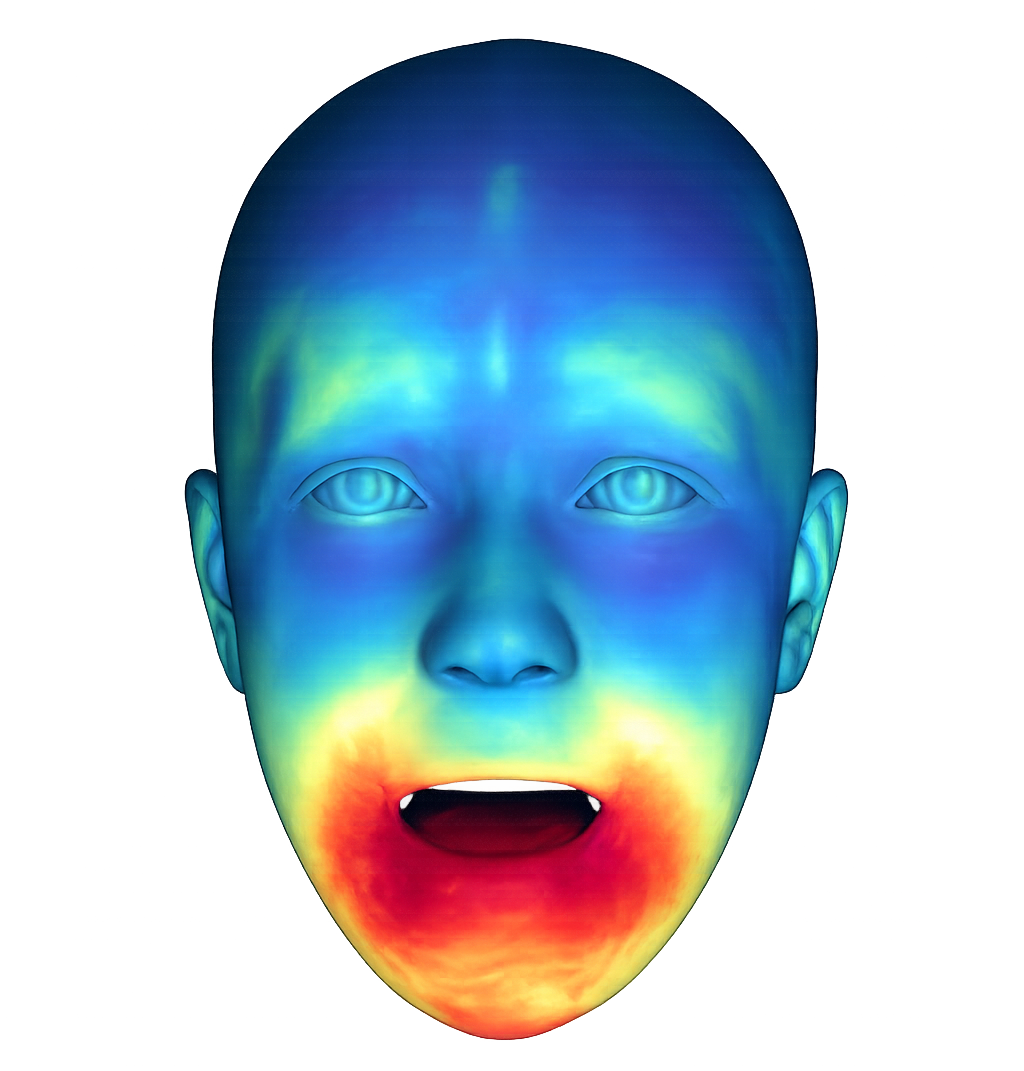
Disclaimer: the image is enhanced by AI for the sake of visualization
|
Loki: Representation over Architecture for Diffusion-Based Portrait Animation
Pouyan Navard, Sernam Lim arXiv 2026 Project Page / arXiv / Code Portrait animation diffusion models stack trained modules for expression, pose, and identity to compensate for conditioning on RGB, where these axes are inseparable. Loki replaces that with an identity-orthogonal parametric face model on the driver and lightweight key–value injection for identity — using ~43% fewer inference parameters and 1,496× less training video, with cross-ID reenactment reducing to a coefficient substitution at inference. |
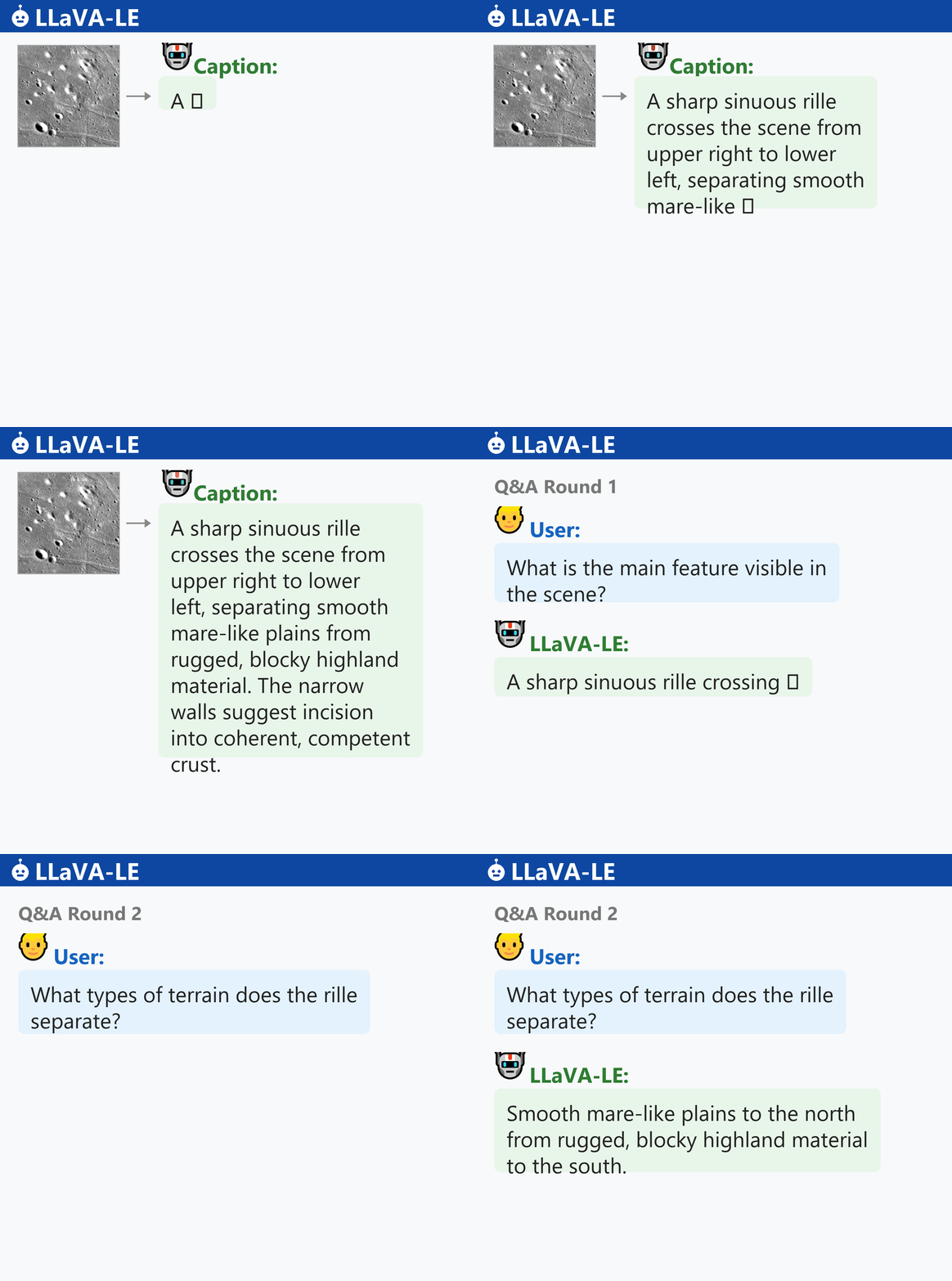
LLaVA-LE captioning and QA on lunar imagery. |
LLaVA-LE: Large Language-and-Vision Assistant for Lunar Exploration
Gokce Inal*, Pouyan Navard*, Alper Yilmaz * Equal technical contribution CVPR 2026, AI4Space Workshop Project Page / arXiv / Code We introduce LLaVA-LE, a vision-language model for lunar surface and subsurface characterization. We curate LUCID, a new dataset of 96k panchromatic images with scientific captions and 81k QA pairs from NASA missions. Fine-tuned with a two-stage curriculum, LLaVA-LE achieves a 3.3x gain over base LLaVA, with reasoning scores exceeding the judge's own reference. |
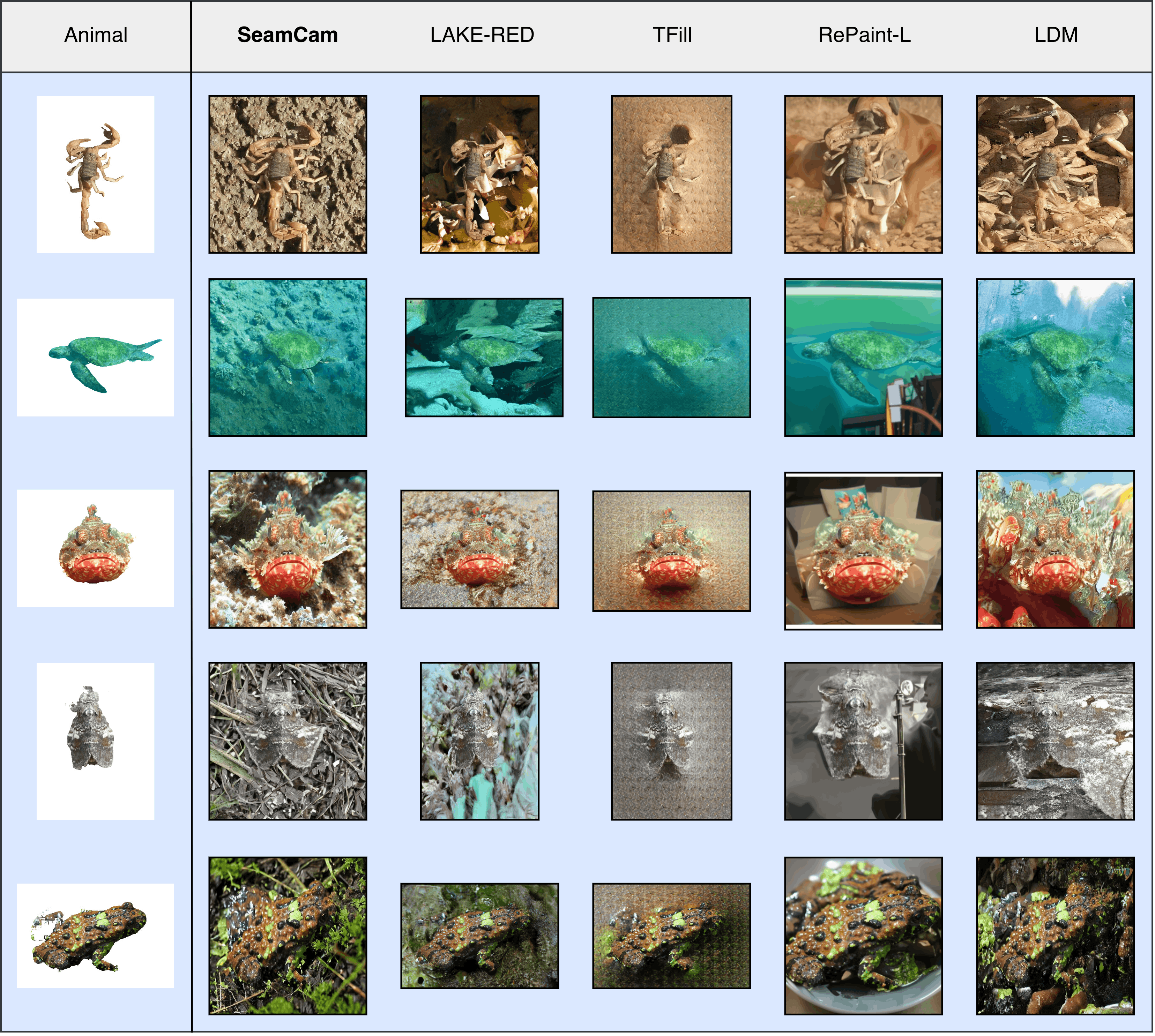
Right-click and open the image in a new tab for better resolution
SeamCam-based camouflage image generation vs. SOTA. |
SeamCam: Quantifying Seamless Camouflage via Multi-Cue Visual Detectability
Amin Karimi Monsefi, Abolfazl Meyarian, Mridul Khurana, Shuheng Wang, Pouyan Navard, Cheng Zhang, Anuj Karpatne, Wei-Lun Chao, Rajiv Ramnath ECCV 2026 (under review) arXiv / Code We introduce SeamCam, a camouflage evaluation metric that quantifies how detectable an animal is from visual evidence. SeamCam achieves 78.82% agreement with human judgments, outperforming state-of-the-art by ~25%. We further use SeamCam as a preference signal for DPO fine-tuning of diffusion-based inpainting models for camouflage generation, and introduce CamFG-1.5k, a curated benchmark of 1,521 high-resolution images for unbiased evaluation. |
|
Sketch-to-image generation with adjustable detail. |
KnobGen: Controlling the Sophistication of Artwork in Sketch-Based Diffusion Models
Pouyan Navard, Amin Karimi Monsefi, Mengxi Zhou, Wei-Lun Chao, Alper Yilmaz, Rajiv Ramnath CVPR 2025, CVEU Workshop Project Page / arXiv We introduce KnobGen, a dual-pathway framework that bridges the gap between novice sketches and expert-level image generation. Our system dynamically balances fine-grained detail and high-level control using adjustable modules, producing high-quality results from any sketch. |
|
3D medical image segmentation results. |
SegFormer3D: an Efficient Transformer for 3D Medical Image Segmentation
Shehan Pererra*, Pouyan Navard*, Alper Yilmaz * Equal contribution CVPR 2024, DEF-AI-MIA Workshop Project Page / CVF / Code SegFormer3D redefines 3D medical image segmentation with a lightweight hierarchical Transformer that rivals state-of-the-art models. By blending multi-scale volumetric attention with an all-MLP decoder, we achieve competitive accuracy with 33x fewer parameters and 13x lower compute. |
Academic Service |
Journals: IEEE TPAMI (2026)
Conferences: CVPR, ICCV, ECCV, ICLR, AVSS, ACCV, SIBGRAPI (2023–2025) |
|
Design and source code from Jon Barron's website. |